For some time now, we have been asking the wrong question. We ask whether AI will replace certain jobs. Some people are so certain that have been panicking others!
Then the question arises on whether students should be allowed to use AI. Whether universities can detect it. Whether employees will become too dependent on it.
A sense of one crisis after the other has become part of our lives, when we should actually think to utter a more interesting question such as this:
How do we educate people to use increasingly intelligent technology without becoming less thoughtful, less creative and less human themselves?
This is where I believe experiential education has an entirely new role to play.
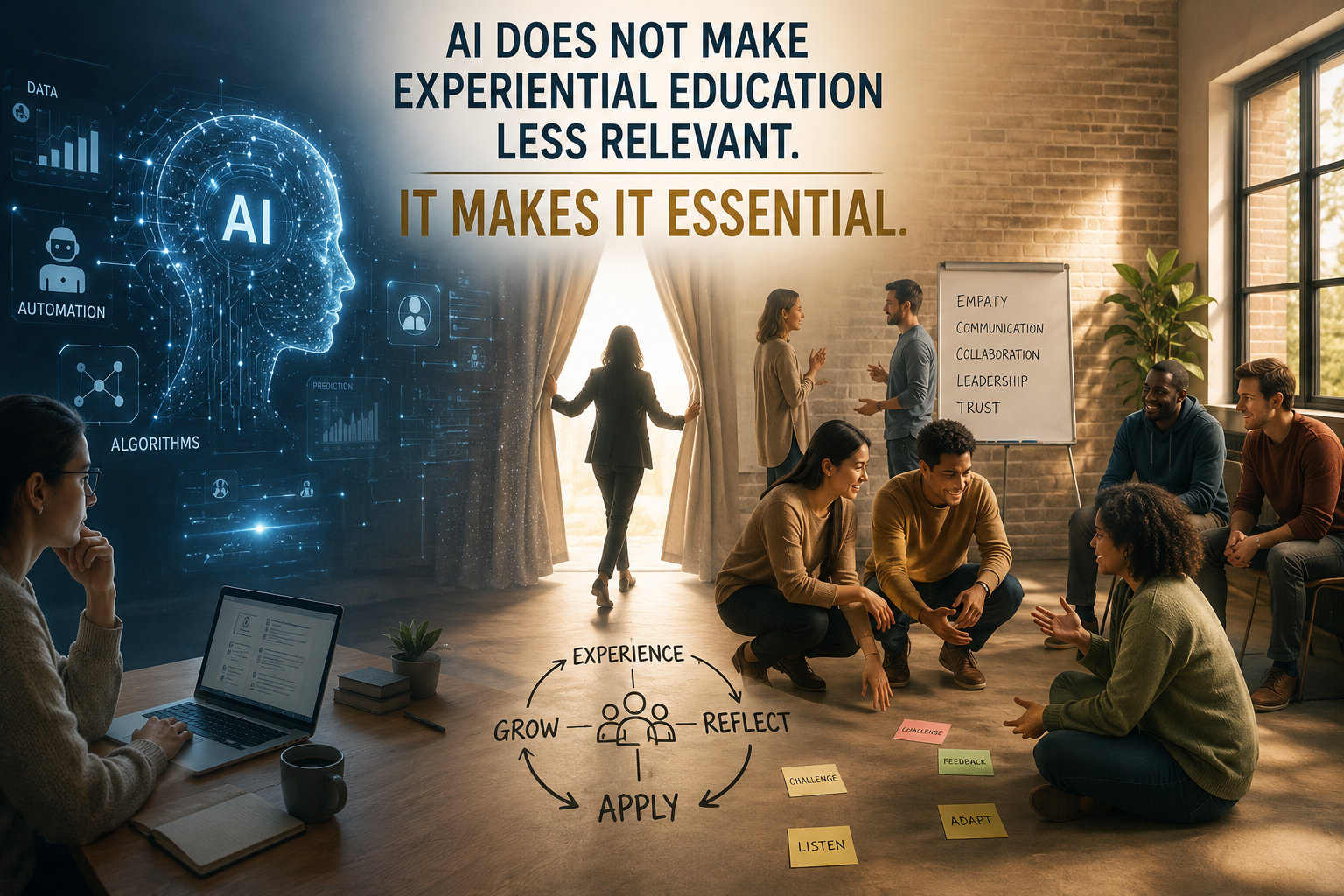
Experiential learning should not be positioned as the alternative to artificial intelligence. It should become the pedagogy through which people learn to apply AI intelligently within genuinely human situations.
I like to think of AI as the good old encyclopedia from where we would get the information needed for when our teacher would ask as to prepare a paragraph about either Georgraphy or Literature class. The teacher always made a point with these words “Do not copy paste the text, try to read, understand and write the information in your own words, so as to be able to present your findings in class tomorrow without having to read every single word!”

Why then, can’t we ask students, teachers or professionals to utilize AI in the same way? They can surely copy and paste, not everyone wants to sit and do the hard work, but what do you think will happen when they are asked to present their findings in their own words? This is where you can see the skills which will distinguish those who will lead with the help of AI and those who will fall into the trap that AI is leading them and their brain.
Hold the above thought and allow me to take you to another ability of the AI. It can generate a presentation following the instructions you give. But it cannot walk into the room and deliver it for you. Even if it does, it will not be the same as the human connection and communication with the other humans sitting there. There will always be something missing. As Elon Musk pointed in his latest interview recently “There will be nothing AI will not be capable of doing in five years, except being human.”
That said, let’s say there is a situation at the office among employees. It can suggest how to manage a difficult employee. But it cannot experience the tension in the room, notice the hesitation in someone’s voice, adapt its body language, or decide that perhaps this is the moment to stop talking and listen. Although AI can draft the perfect response to a conflict, it still falls on human beings to still have to have the conversation.
And that gap between knowing what to say and knowing how to act is precisely where experiential education becomes so powerful.
We need to rehearse the human part
My background in theatre has taught me something that I increasingly believe belongs in education and organizational development: understanding something intellectually is not the same as being able to perform it under pressure.
As actors we do not simply read about listening, we practice active listening. We do not listen to respond our lines; we listen to understand and then respond accordingly.
As actors we do not study adaptability only as a concept, but we are always alerted to improvise. And yes, we rehearse, we fail, we receive feedback, we adjust and we try again.
Why shouldn’t we approach leadership, communication and even the use of AI in the same way? Imagine a university classroom where students use AI to prepare for a negotiation, and then have to conduct the negotiation with another human being. There is a case scenario to be performed via role play.
Or a leadership programme where managers ask AI to propose solutions to a difficult workplace conflict but then they role-play the conversation and discover which recommendations actually work when emotion, personality, hierarchy and uncertainty enter the room.
Suddenly, AI is not replacing learning.
It is becoming material for learning.
This is where S.T.A.G.E.™ enters the conversation
I developed the S.T.A.G.E.™ Leadership Method around five capabilities that I believe are becoming even more valuable in an AI-driven world:
Self-Awareness. Trust. Adaptability. Growth. Execution.
AI can support all five. But it cannot develop them on our behalf.
Self-Awareness asks us to understand how we show up — something no prompt can outsource. Trust reminds us that leadership still happens between human beings. Adaptability develops our ability to respond when reality refuses to follow the script. Growth comes through practice, feedback and reflection, rather than simply receiving the correct answer. And Execution is the moment when knowledge must become behavior.
This is why I see S.T.A.G.E.™ not simply as a leadership framework, but increasingly as a bridge between technological intelligence and human capability.

The question for universities and organizations should therefore move beyond: How do we teach people to use AI; thus, we should be asking:
How do we develop people who can question it, interpret it, challenge it, communicate with it, and then walk into the complexity of the real world and know what to do?
That requires something AI cannot provide on its own. Experience. Because the future of education will not belong to institutions that force students to choose between technology and humanity. It will belong to those that understand how powerfully the two can work together. And perhaps that is the real opportunity before us: not protecting human skills from AI but using AI as the reason to develop them more deliberately than ever before.